5th Infraday Florida Recap
I had the opportunity to attend the 5th annual Infraday Miami conference this year, which brought together public owners, consultants, technologists, and investors to deliberate on Florida's strategies for planning, funding, and implementing infrastructure over the next decade. The central theme was Connection, focusing on the integration of vision, capital, and technology to produce resilient, high-performing assets in transportation, water, energy, and digital infrastructure.
Below, I've compiled my responses to key questions posed during the panel, edited for clarity and expanded with additional context. These insights draw from my experience advising on multi-billion-dollar capital programs, where I've observed firsthand how fragmented data practices can derail even the most ambitious projects. For those unfamiliar, terms like PMIS (Project Management Information System) refer to digital platforms that centralize project data, workflows, and collaboration essential for large-scale infrastructure but often mishandled in public sector environments.
Panel context and participants
Airports were framed as some of the most economically critical assets in the United States: they enable regional growth, national connectivity, global trade, and public safety, yet much of the underlying infrastructure is aging and operating beyond its original design life. This creates a dual challenge: expand and modernize while staying operational and safe 24/7.
The panel was moderated by AJ Waters, Chief Evangelist at Kahua, author of the TheEngiNerdLife blog, covering the intersection of construction and technology. On the panel I was joined by Rich Miesemer, IT Program Manager, Engineering and Construction (Parsons Corporation), and Todd Procaccini, Senior Client Executive (Kahua), combining perspectives from owner advisory, engineering, and platform delivery.
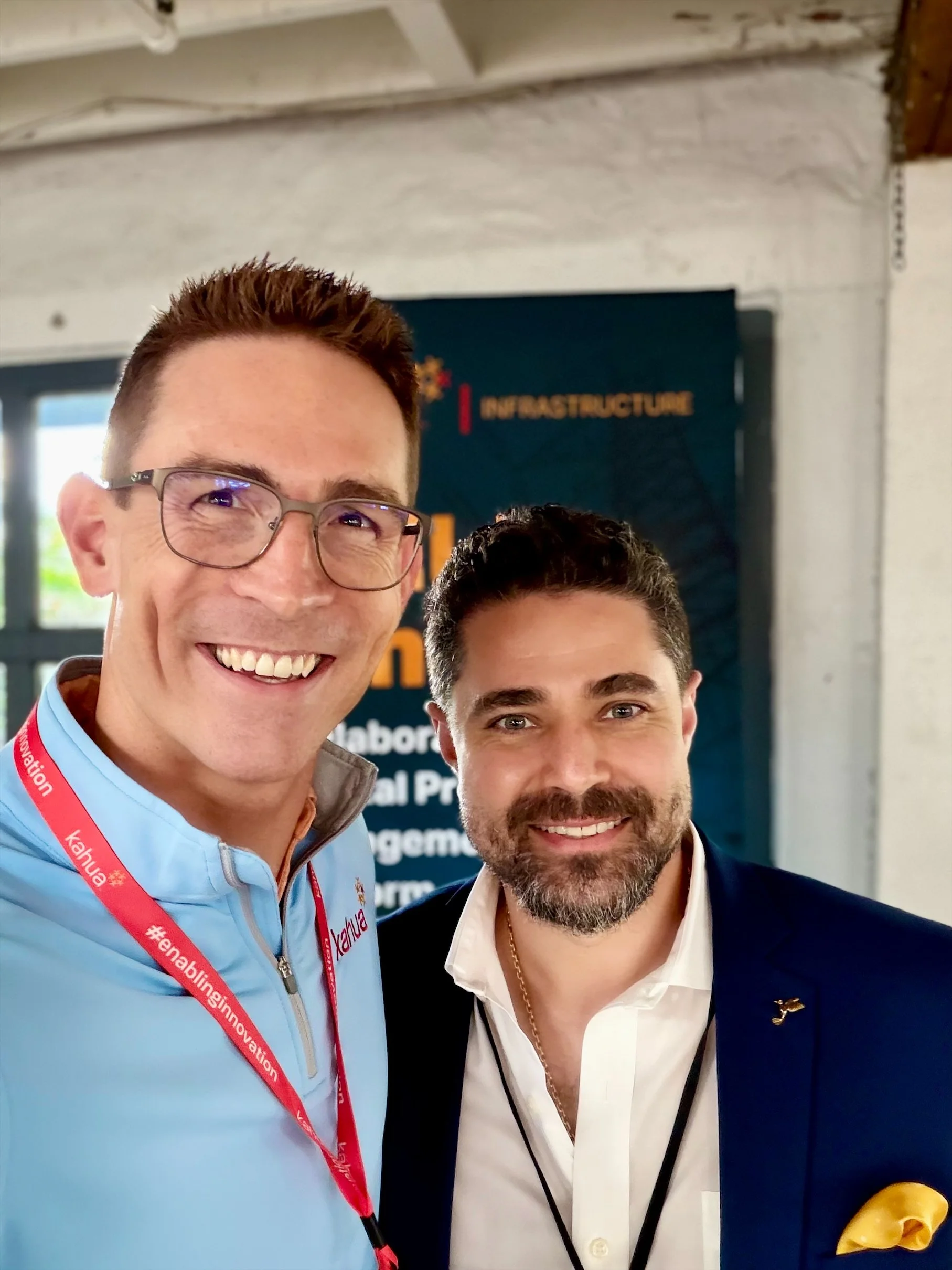
I also had the opportunity to reconnect with several Florida infrastructure leaders and old friends, Sean Justiniano, Enterprise Sales Director (Frontrol) and Vijay Mishra, Principal Project Manager (South Florida Water Management District).


Q1: Airports are some of the most complex construction environments in the world. Arthur, what do you think is the biggest challenge?
Airports are among the most complex construction environments in the world because projects unfold in live, security-sensitive, revenue-generating facilities that cannot simply shut down. Airports must phase work carefully around passengers, airlines, security protocols, and airfield operations, often over many years.
From my perspective, the single biggest challenge is the lack of continuity across multi-decade capital programs caused by fragmented digital systems and project-by-project decision-making. Owners tend to treat each project as an isolated event, which leads to: repeated procurement of different tools and platforms for each project, siloed data that cannot be easily integrated or reused, loss of institutional knowledge during periods of team (project team, contractors, consultants) turnover, higher cost and schedule risk because past lessons and data are not systematically leveraged. In effect, owners often relinquish control of their most valuable asset - program data - to contractors and consultants, rather than managing it as a strategic, long-term asset.
Q2 – From the capital advisory perspective, where is delivery risk is introduced?
From a capital advisory perspective, airports often introduce delivery risk unintentionally by treating digital infrastructure as a project-specific expense rather than as an enterprise, owner-controlled platform. Key risk patterns include:
Procuring different PMIS or point solutions for each project. While this approach has strategic benefits for organizations with low organizational and/or digital maturity by allowing them to deploy capabilities to specific projects quickly, it’s not without drawbacks and risks. At the end of the day, unless these capabilities are integrated into the organization’s general PMO, governance and data silos make it challenging to unify in the future.
Allowing contractors to select, host, and control the primary collaboration and project platforms. Some owners see this as an easy way out, but this is perhaps the most damaging approach an owner organization can take. Not only is the Source of Truth with your service provider, but the solutions you are using are configured to meet external party organizational needs and requirements, and will lack the depth and functionality required by the owner organization. At the end of the project, governance, systems, and critical data effectively “walk away” at closeout.
Under-investing in an owner-configured, centralized data environment. Yes, deploying and managing your own PMIS can be a significant investment. It requires specialized personnel that understand your organizational processes and technology. But it’s an imperative requirement in moving up the organizational and digital maturity ladder that are now so closely linked you can hardly tell them apart. Failing to set enterprise-wide data standards, deploy and manage systems, and control the data will negatively impact all other organizational initiatives aimed at increasing organizational capabilities and providing insight into project performance.
These decisions compound risk over time, turning what should be a strategic advantage (cumulative program knowledge) into a persistent liability.

Q3 – How can owners maintain governance and continuity across multi-year or multi-decade capital programs?
Owners should approach digital infrastructure with the same level of discipline as physical infrastructure, assuming ownership, configuration, and governance at the enterprise level. A common misconception in the industry is that maturity levels can only advance and never regress; however, this assumption holds true only in processes without human involvement, and doesn’t consider shifts in contracts, governance, policies, and other factors. Sustaining governance is an ongoing initiative that requires consistent and vigilant efforts to either preserve or adapt it without adverse consequences. In practice, elevating organizational maturity requires substantial investment, and maintaining it demands equivalent commitment to protect operational efficiency and effectiveness amid continual changes.
Core principles:
From the initial planning phase, evaluate each program’s delivery methods and data governance, confirming that the program and associated contracts align with the current governance framework or implement adjustments to strengthen governance in support of the intended goals. Remember that governance should support your contractual obligations and empower you to be a strong counterparty to your vendors.
Implement a unified, owner-hosted and owner-configured platform that encompasses all projects and programs. It’s advisable for owners to prioritize identifying contract types as the mechanisms that establish contractual relationships with service providers, and assess them through the perspective of existing governance. This involves pinpointing any discrepancies or conflicting aspects that could pose challenges during the digital enablement phase. Developing an operating model and defining precise functional requirements for selecting the PMIS is essential and should precede any system-specific discussions. This preparatory step embodies the principle of measuring twice before cutting once, with system implementation following as the decisive action.
Define explicit data ownership policies, ensuring that all project data is channeled into the owner’s platform in real time; contractors may access it but do not exercise control. The owner’s system serves as the single source of truth (SSoT) for the delivery team and is acknowledged as such by vendors. This aspect is typically incorporated through the contracting process by requiring service providers to utilize the owner-designated systems, or to maintain and submit deliverables such as schedules using specific software (such as Oracle Primavera P6) in a predefined format.
Introduce standardized workflows, templates, and metadata structures from the outset to promote uniformity across projects and teams. This represents one of the most challenging components of governance management, given the diversity of contract types and the subtleties involved in overseeing the delivery of various asset categories. It encompasses not only the administration of processes and data but also the management of personnel and attitudes, where resistance to change is often encountered. Achievement in this domain requires a steadfast emphasis on ultimate objectives, dedication, and persistence.
Establish centralized governance positions, such as a program data steward, accountable for managing access, ensuring quality, and overseeing long-term retention. Functions performed by these roles are a critical component in preserving the quality of your investment.
This approach helps preserve institutional knowledge, reduces the impact of staff turnover, and creates a reliable foundation for analytics, compliance, and future AI applications.
Q4 - Practical AI use cases and prerequisites.
I've witnessed firsthand how emerging technologies reshape project delivery. In the realm of infrastructure, particularly in high-stakes sectors like aviation and transportation, AI isn't poised for a revolutionary "big bang" disruption. Instead, I think that AI adoption will unfold as a deliberate, managed evolution spanning decades. This measured pace keeps human expertise at the core of project management, ensuring accountability and nuanced decision-making. From this lens, AI shines brightest in data analysis roles: sifting through vast datasets to deliver quantitative and qualitative insights that empower human teams, without usurping final judgments.
Summarized below are several realistic, near-term AI use cases achievable within 12–24 months for construction teams new to the technology. These aren't pie-in-the-sky visions but grounded applications that integrate seamlessly with modern PMIS platforms, enhancing efficiency and reducing errors. However, success hinges on robust prerequisites. Without a solid data infrastructure and control over your project's information ecosystem, AI efforts risk devolving into costly experiments yielding unreliable or misleading outcomes.
AI use cases in construction:
AI's value in construction infrastructure lies in automating repetitive, data-heavy tasks, freeing professionals to focus on strategic oversight. When embedded within a PMIS, these tools amplify project visibility, compliance, and quality control. Here are three practical examples, each backed by recent industry implementations:
Document management automation. In construction projects, managing drawings, invoices, and compliance documents is notoriously labor-intensive, often requiring minimal human oversight yet prone to errors. AI excels here by analyzing documents, detecting conflicts (e.g., design discrepancies), auto-populating fields from drawings or comments, and verifying regulatory compliance. This not only accelerates workflows but also integrates directly with PMIS for real-time updates. > Industry Insider / TxDOT Transforms AI Strategy Into Agencywide Implementation shared by Anh Selissen, Chief Information Officer at Texas Department of Transportation
Defect detection and on-site inspections. Leveraging computer vision and machine learning, AI can identify material defects, construction inconsistencies, and quality issues in real-time—often outperforming traditional manual methods in both speed and precision. Drones and robotic systems further amplify this by conducting autonomous inspections in hazardous or hard-to-reach areas, feeding data back into PMIS for immediate action.
Insights from a 2025 study on AI in aviation construction projects in the United Arab Emirates highlight this potential. Construction professionals reported that integrating AI has led to reductions in operational, construction, and labor costs from 5% to 10%. For instance, in Dubai's airport expansions, AI tools integrated with PMIS reduced inspection downtime, underscoring the technology's role in elevating project safety and efficiency. > The Role of Artificial Intelligence in Aviation Construction Projects in the United Arab Emirates: Insights from Construction Professionals
Runway and pavement condition assessments. For aviation infrastructure, AI-powered systems using drone imagery and machine learning algorithms can detect pavement cracks, distress, and wear with exceptional accuracy. These tools process data at speeds unattainable by humans, allowing assessments without disrupting operations—a critical advantage in busy airports.
A standout 2024–2025 deployment involves AI-driven runway inspections achieving 96% accuracy and 3-millimeter precision, completing evaluations up to eight times faster than conventional methods. As detailed in recent industry reports, implementations at major U.S. airports like those managed by the FAA have integrated these insights into PMIS dashboards, enabling predictive maintenance that extends asset lifespans by 15–20% and cuts operational interruptions. This not only boosts safety but also aligns with sustainability goals by optimizing resource use. > Transforming Runway Inspections with AI-Powered Precision
Prerequisites for effective AI implementation: building a solid foundation
While some AI applications can launch with minimal setup, their true impact and ROI scales dramatically with strong foundational elements. In my experience advising on PMIS rollouts, overlooking these prerequisites turns AI into an expensive novelty rather than a strategic asset. Treat the following as a readiness checklist; without these prerequisites, projects risk data silos, inaccuracies, and security vulnerabilities.
A centralized, owner-controlled data repository
Uniform data classification, tagging, and metadata standards
Ample volume of reliable, sector-specific data
Robust data governance framework
Q5 - One piece of advice for leaders.
If I had to leave airport and infrastructure leaders with one message, it would be this: treat your digital platform as critical infrastructure. Own it, configure it deliberately, and make it the single source of truth for your entire capital program. The entity that controls the data ultimately shapes the outcomes: risk exposure, cost performance, transparency, and readiness to adopt AI and other emerging tools. Choosing to own and govern the data is no longer a technical preference; it is a strategic leadership decision.
Despite bold claims, generative AI is poised to follow the failed paths of BIM, blockchain, and other technologies in construction, where 95% of pilots deliver no ROI amid persistent productivity declines and data challenges.